
Mechanics of Breathing
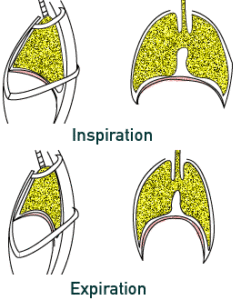
Gas exchange will only occur if the alveoli are regularly flushed with fresh air; this happens with each breathing cycle when air is drawn in and out of your lungs. The primary muscle of breathing is the dome shaped diaphragm. Because the diaphragm contracts as it flattens, it increases the size of your chest cavity by making it longer. The external intercostal muscles also contract during inspiration, pulling the sagging ribcage upward to help the diaphragm increase the chest size. The expanding chest cage stretches the lungs along with it. As the lungs expand, they cause air to be sucked in through the nose and down through the trachea.
Think of a piano accordian – as it expands it sucks in air which it then forces out again in the next note. Your lungs are never completely empty when you breathe out. As your lungs begin to expand, the air inside suddenly has more room. As it spreads out, the pressure drops, and this creates a vacuum. The vacuum sucks air from the atmosphere down into your lungs until the air pressure is equal both inside the lungs and in the air outside your body.
Diaphragm
When you breathe out, the inspiratory muscles relax, the diaphragm assumes its rested curved shape. This allows the chest cavity to return to its original – or resting – size. The lungs also shrink to their resting size and so the air is compressed into a small space. This makes the air pressure in the lungs higher than in the atmosphere. In an effort to equalise pressure the air is pushed out, usually passively, without the aid of any muscles.
During strenuous activity, eg. exercise or an asthma attack, expiration becomes active. New sets of muscles are used. Muscles of the abdominal wall contract, pushing the diaphragm upward while the contraction of the internal intercostal muscles, in opposition to the external intercostal muscles, pulls the ribcage downwards. These actions combined accelerate the expulsion of air.
As a person increases the size of his breaths, the inspiratory muscles have to work harder and harder because the resistance to this stretching becomes increasingly stronger. The lungs are like a rubber band or balloon, the more they are stretched, the more effort it takes to keep stretching them further.
Airway resistance is the force opposing the flow of air in and out of the lungs. Resistance is a friction-like force that is created when air moves past the airway walls. During inspiration, both lungs and airways expand in response to the decreased air pressure; the widened airways offer less resistance. During expiration, the reverse occurs, and resistance increases.
The amount of resistance depends on both how wide your airway is and how fast the air is travelling. If your airways narrow to half their normal width then resistance increases 16 times. Your respiratory muscles have to work harder to continue to breathe at the same speed.
Resistance is greatest in the medium-sized bronchi and these are the airways primarily affected in asthma. Asthma causes a large increase in airway resistance – and therefore in the work of breathing. The resistance can also be altered by contractions of bronchial smooth muscle, which narrow the passages and increase resistance. The muscles are under control of the autonomic nervous system.
To understand what is happening, breathe through a drinking straw while it is fully open, and then after you pinch it partially closed. Repeat this experiment, but breathing more quickly. This explains why you have much more difficulty exhaling when you have asthma.